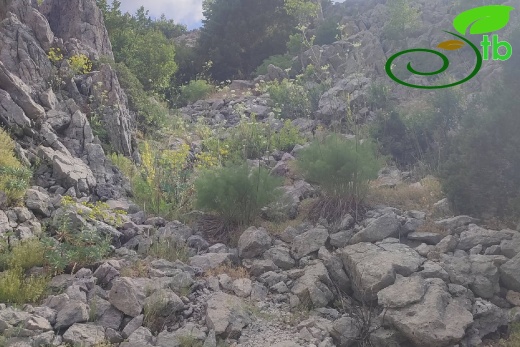

Diplotaenia hayri-dumanii
Diplotaenia hayri-dumanii
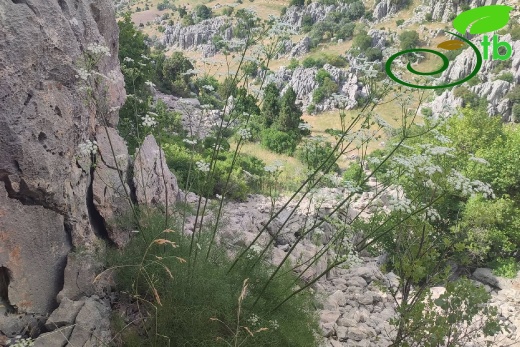
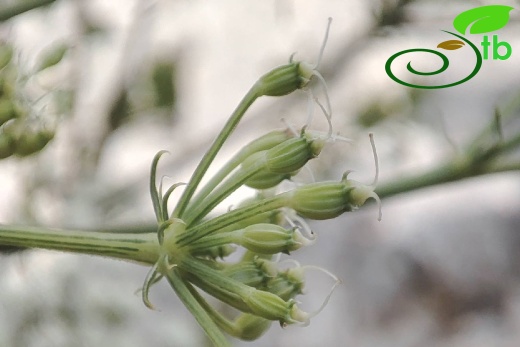
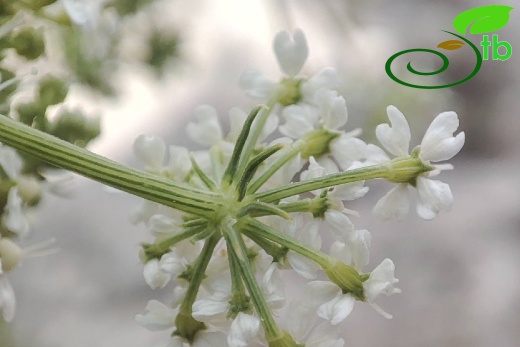
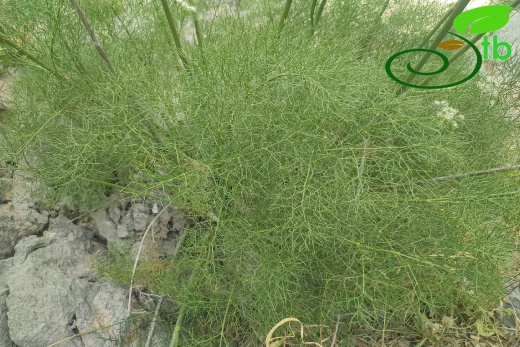
Polycarpic perennials with taproot. Stems 1.5 – 1.7 m high, c. 5 mm in diam. at the base, almost completely glabrous, finely striate, rounded at cross-section in lower part, ribbed under inflorescence, with alternate lower branches and verticillate or opposite upper branches, much overtopping the central umbels. Basal leaves rosulate, outer soon withering but not falling off, with long sheaths and small blades; central leaves with petioles almost rounded in cross-section, to 30 cm long, their blades ovate at outline, to 40 cm long, 4 – 5-pinnatisect; their segments with long petiolules, terminal lobes filiform, ± curved, divaricate, 1 – 2 cm long, up to 0.5 mm in diam. Upper stem leaves very simplified, their sheaths triangular, narrowly white-membraneous at the margin, almost without blades. Central umbels without peduncles or with very short peduncles, 8 – 12-rayed; rays very unequal, 2 – 5 cm long, finely furrowed, somewhat scabrous; bracts 7 – 8, lanceolate, entire, herbaceous, white-membraneous at the margin, reflexed. Umbellets with 20 – 25 flowers; pedicels at flowering 1 – 5 mm long, bracteoles 5 – 7, entire, narrowly lanceolate, very shortly scabrous at the margin, reflexed. Calyx teeth well developed, lanceolate, hooked. Petals white, up to 2 mm long, obovate, cuneate at the base, emarginate at the tip, with short lobe bent inwards, attached to petal blade, with secretory ducts almost inconspicuous. Fruit elongate, up to 4 – 5 mm long; stylopods conic, styles up to 2.5 mm long, reflexed at mericarp dorsal side.
Endemic.